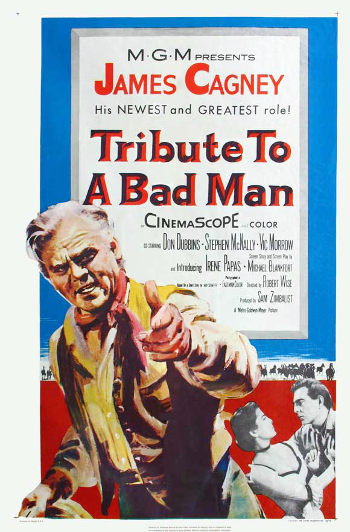
 James Cagney is Jeremy Rodock, a tough-as-steel, no-nonsense horse rancher who controls the valley where he’s established his ranch.
He makes his own law, and when someone steals from him, he tracks them down and hangs them, no questions asked.
Don Dubbins is Steve Miller, the Easterner who rides into the valley and rescues Rodock when he’s pinned down by two rustlers.
Rodock returns the favor by giving Miller a job. Problem is, the young man almost instantly falls for Jocasta Constantine, a former dance hall girl Rodock has taken in.
Rodock loves her; she’s quite fond of him, too, except for when he gets hanging fever.
Being the only female around, she attracts quite a bit of attention. McNulty, Rodock’s top hand, gets fired for flirting with her.
Plotting revenge, he steals several of Rodock’s mares and foals, then cripples the mares so they can’t run off.
As usual, Rodock sets out on the trail of the rustlers. This bout of hanging fever might push young Steve Miller and Jocasta out of his life forever.
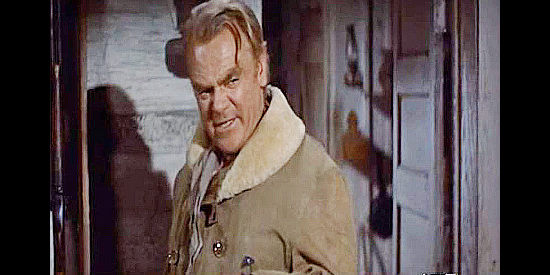
James Cagney as Jeremy Rodock, explaining why he has to serve up his own strict justice in Tribute to a Bad Man (1956)
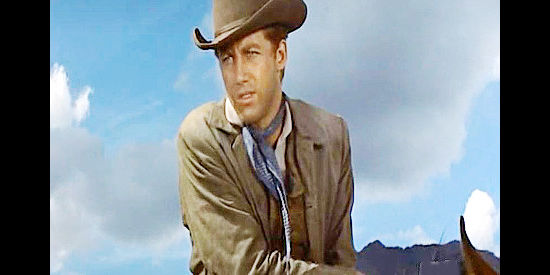
Don Dubbins as Steve Miller, arriving in Rodock valley and spotting a rancher in trouble in Tribute to a Bad Man (1956)
 Review:
During a career that basically spanned four decades, James Cagney saddled up just three times. His most well-known Western is likely 1939’s “The Oklahoma Kid,” opposite Humphrey Bogart. But the two Cagney oaters that should be on Western fans must-see list are the two he made in the 1950s — this film and 1955’s “Run for Cover.”
In each, Cagney takes a young man under his wings. This time around, it’s Don Dubbins as Steve Miller, a young Pennsylvanian who doesn’t know the first thing about raising horses, but likes the idea of the romantic West, minus the violence.
Then there’s cigarette-smoking Jocasta Constantine, who comes off much more realistic than most former saloon girls we meet in 1950s Westerns. She knows she took the easy way out once she immigrated to America with her family. Like Miller, she admires Jeremy Rodock, loves him even, except when he’s dishing out Rodock law.
They make for an unlikely love triangle with an unlikely outcome. And over the course of the film, Director Robert Wise once again reminds us that a Western doesn’t have to be chock full of shootouts, stampedes, barroom brawls and horse chases to be entertaining.
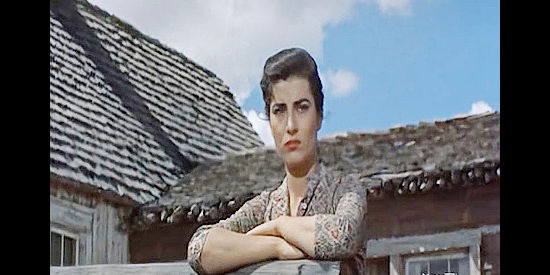
Irene Papas as Jocasta Constantine, in love with Jeremy Rodock but not his violent ways in Tribute to a Bad Man (1956)
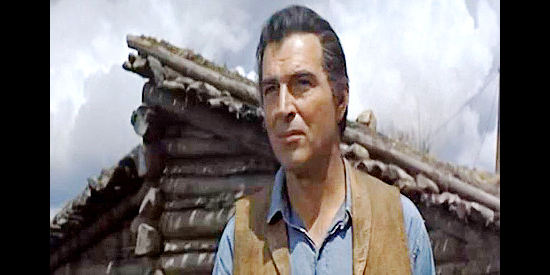
Stephen McNally as McNulty, the Rodock ranch hand who lusts after Jocasta Constantine in Tribute to a Bad Man (1956)
Directed by:
Robert Wise
Cast:
James Cagney … Jeremy Rodock
Don Dubbins … Steve Miller
Stephen McNally … McNulty
Irene Pappas … Jocasta Constantine
Vic Morrow … Lars Peterson
James Griffith … Barjack
Onslow Stevens … Hearn
Lee Van Cleef … Fat Jones
Peter Chong … Cooky
Royal Dano … Abe
Chubby Johnson … Baldy
Jeanette Nolan … Mrs. L.A. Peterson
James Bell … L.A. Peterson
Runtime: 95 min.
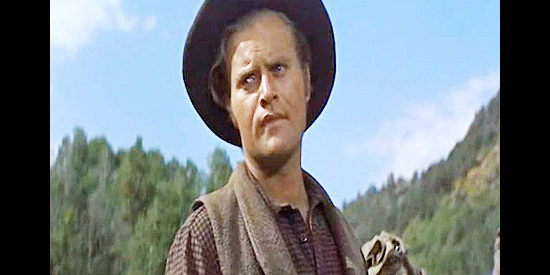
Vic Morrow as Lars Peterson, whose family has a long-standing grudge against Jeremy Rodock in Tribute to a Bad Man (1956)
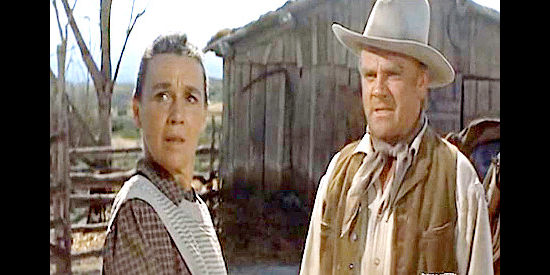
Jeanette Nolan as Mrs. Peterson as Jeremy Rodock (James Cagney) encourages her to head back East in Tribute to a Bad Man (1956)
Memorable lines:
Jeremy Rodock, as Steve Miller extracts a bullet from his back: “Don’t you keel over on me, you Pennsylvania egg sucker.”
Jeremy Rodock, explaining the philosophy behind Rodock Law: “Let one buzzard live, and he’ll pick you clean.”
Fat Jones, to Steve as he moves into the bunkhouse: “Say, friend… You don’t just happen to have one of them new mail order catalogues?”
Steve Miller: “No, I ain’t.”
Jones, tossing a knife in frustration: “Feller told me they had pictures in them this year – women in corsets.”
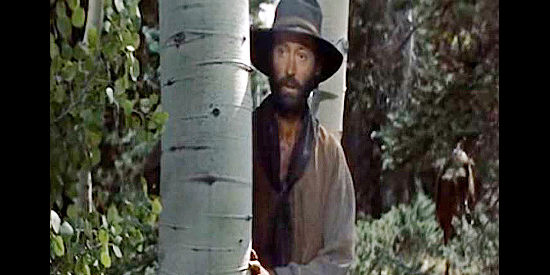
James Griffith as Barjak, one of the men who enter into a rustling scheme with McNulty in Tribute to a Bad Man (1956)
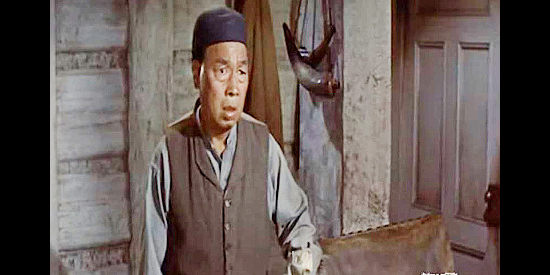
Peter Chong as Cooky, not sure how to answer when Jeremy Rodock asks for advice on dealing with women in Tribute to a Bad Man (1956)
Jeremy Rodock: “I ain’t got you figured yet, McNulty. You act like a man with a lot of ideas. All of them second-rate. And not one honorable.”
McNulty: “Correct.”
Jocasta Constantine: “I’d lend you more (money), if you would use the money to go back home.”
Steve Miller: “Go home? Why?”
Jocasta: “Steve, we’ve only talked a few times since you came here. But I know this about you. You are gentle. You haven’t been used, and made hard. This is not your kind of life. Look at the men in the bunkhouse: Baldy, and Fat Jones, and Abe. Never a chance for a family, or a home. In ten years, you’re gonna’ be like them – a “nobody” on a horse. That’s what a wrangler is: a “nobody” on a horse. With bad teeth, broken bones, double hernia, and lice.”
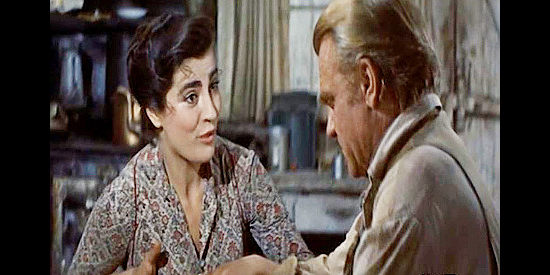
Irene Papas as Jocasta Constantine, expressing her gratitude to Jeremy Rodock (James Cagney) in Tribute to a Bad Man (1956)
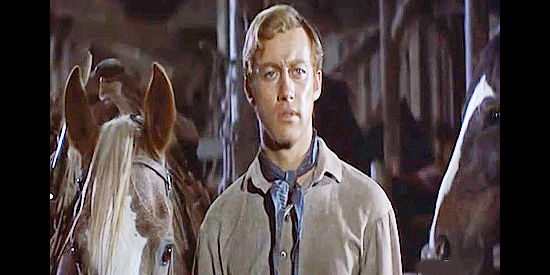
Don Dubbins as Steve Miller, ordered to help throw McNulty off Jeremy Rodock’s spread in Tribute to a Bad Man (1956)
Jeremy Rodock: “It’s fear keeps men honest. And with that hanging today, I laid fear like a fence 10 feet high around my property.”
Jeremy Rodock to Steve: “A fella doesn’t die of a broken heart from his first love, only from his last.”
Steve Miller, as Rodock marches three horse thieves, shoeless, to a nearby town: “This ain’t punishment, Mr. Rodock. It’s revenge. It ain’t human.”
Jeremy Rodock: “I’m sorry you’re so hard, boy.”
Lars Peterson: “I learned from you.”
Rodock: “Then I’m sorry for both of us.”
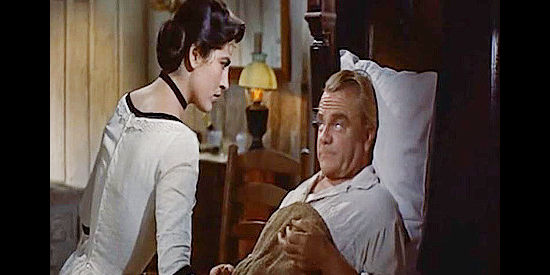
Irene Papas as Jocasta Constantine, trying to convince Jeremy Rodock (James Cagney) to stay in bed and rest in Tribute to a Bad Man (1956)
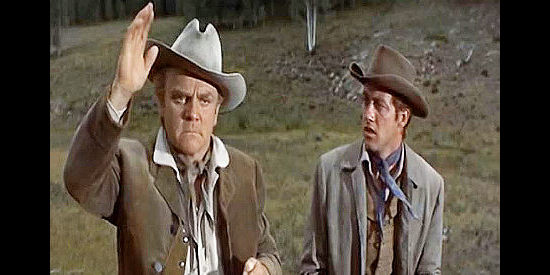
James Cagney as Jeremy Rodock, about to give the signal to proceed with a lynching while Steve Miller (Don Dubbins) looks on in Tribute to a Bad Man (1956)
)
This is a very interesting Western with a complex but lucid plot, a very strong performance from Jimmy Cagney, and praiseworthy support from Irene Papas, Don Dubbins and Stephen McNally, who bears a rather strong resemblance to Martin Landau, one of my favorite actors. Oh, it’s also got Lee van Cleef, which is unfailingly a tremendous boost to any Western.
TtaBM is certainly one of the most romantic Westerns I’ve seen. Statuesque ci-devant saloon girl Jokasta (Papas) is living with wealthy, hard-bitten horseman Rodock who is also a sawed off cuss approximately a quarter century older than her. It looks like the classic case of a gold-digging woman who uses her beauty to ensnare a man who means little to her beyond a life of opulence. And some of the younger hands–McNulty (McNally) and Miller (Dubbins)–sense this. Like sharks to a lacerated tuna, they home in on Jokasta, hoping to rip her away from the older man.
Papas does an excellent job of portraying ambivalence about Rodock. On the one had she is truly grateful for what he’s done for her and does have genuine affection for him, although she is also rather repulsed by his violent ways, which include hanging any horse thief who dares trespass on his ranch. On the other, she doesn’t seem to be physically attracted to him. Will Jokasta remain loyal to Rodock, or will she abandon him for a younger man? This is the crux of the plot.
Ancillary to the central theme is Rodock’s character. He’s clearly a very rough cob, which is the reason for the adjective “bad” in the film’s title. But is he truly bad? In the largely lawless Old West powerful men, or groups of them, became laws unto themselves out of necessity. And, with genuine threats to life, limb and livelihood constantly on the prowl, they could either be harsh or they could be dead.
Furthermore, McNulty, who eventually reveals himself to be a considerably worse man than Rodock, maims the mares in Rodock’s remuda as part of a scheme to claim their foals as his own. It is truly a vile act justifying the most severe of punishments.
Rodock, after apprehending McNulty and his two henchmen, starts down this path–quite literally–only to relent under the conscience-pricking admonitions of Miller (Dubbins). In a gout of sticky compassion, Rodock spares the men who mutilated his horses. Is this kinder, gentler Rodock more admirable than the Old Testament Rodock? In my opinion, no. Other viewers may disagree. Regardless, this film does a great job of portraying moral quandary as well as the character of its leading figure.
TtaBM is aesthetically beautiful. The cinematography and color are grand and rich. Music–both Miklos Rosza’s score–and various folk tunes played on the piano and some sort of rude flute, add to the picture’s attractiveness.
The entire package is most satisfying, and for this reason, every true devotee of the Western genre should watch this film.