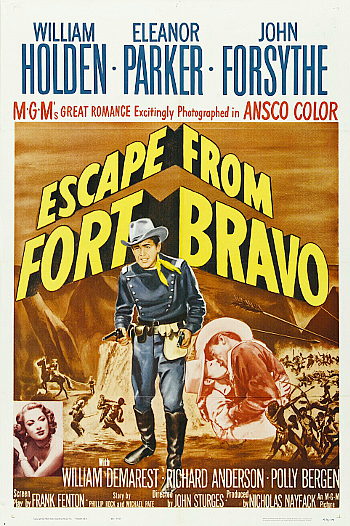
 William Holden plays Capt. Roper, a no-nonsense Union cavalry commander stationed at a Western outpost in Arizona during the Civil War.
The fort doubles as a Confederate prisoner of war camp, and Roper’s the man responsible for tracking down those who try to escape.
Then lovely Carla Forester (Eleanor Parker) arrives at Bravo to take part in her best friend’s wedding.
She has an ulterior motive as well, helping her love — Confederate officer John Marsh (John Forsythe) — and three of his men escape.
To do that, she charms Roper to the point where he proposes marriage, only to wake up one morning and find his lady love and four prisoners missing.
Notorious for being heartless before Carla’s arrival, he sets out on their trail and catches up with them.
But so do the Apaches.
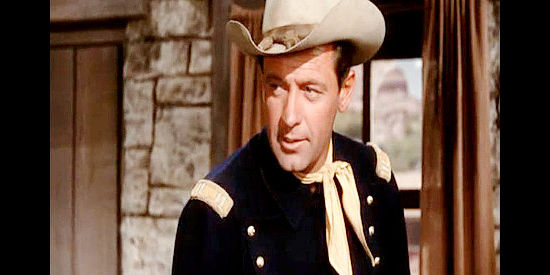
William Holden as Capt. Roper, learning his new love has disappeared with the Confederate escapees in Escape from Fort Bravo (1953)
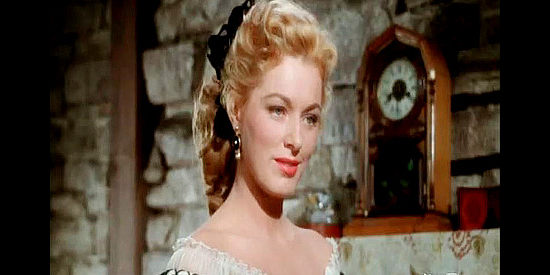
Eleanor Parker as Carla Forester, beginning her mission of turning Capt. Roper’s head to help her beau gain freedom in Escape from Fort Bravo (1953)
 Review:
A well-done Western that would have been much better had Sturges and company kept the focus on action and cut some of the purple-prose filled romantic scenes between Holden and Parker.
In one ridiculous scene, Capt. Roper takes Carla sight-seeing in Death Valley — and this film isn’t short on breath-taking scenery — for the purpose of seducing her.
He grabs her. He says he’s imagined her resisting. He’s imagined her not resisting. Bottom line: He’s taking her either way. Ugh!
The good news is that the action scenes are very well done. William Campbell and William Demarest add a touch of humor as bickering Rebel soldiers, one young and full of bluster, the other experienced and as crusty as they come.
And it all leads up to a rousing, memorable climax in which Roper, another Union officer, Carla, Marsh and the three other Confederate prisoners have to take cover in a dry river bed, surrounded by Apache.
Oh, and for a touch of trivia, you’ll notice weapons flying at the screen 3D-style in some scenes. This was not released as a 3D film, but was initially intended to be, which explains those camera angles.
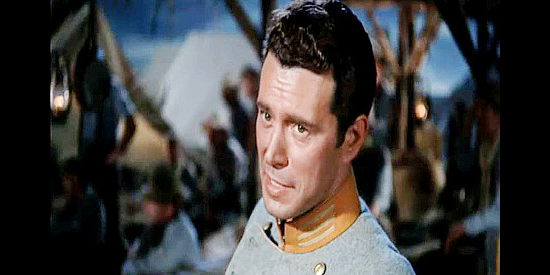
John Forsythe as Capt. John Marsh, carefully planning an escape from a prisoner of war camp out West in Escape from Fort Bravo (1953)
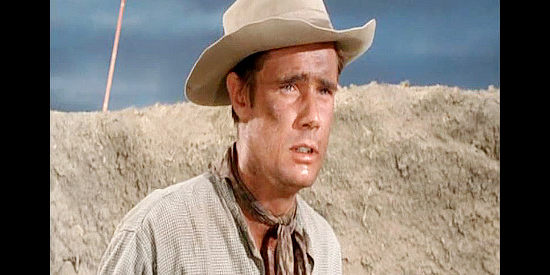
John Lupton as Bailey, the poet and weak-willed Confederate escapee in Escape from Fort Bravo (1953)
Directed by:
John Sturges
Cast:
William Holden … Capt. Roper
Eleanor Parker .. Carla Forester
John Forsythe … Capt. John Marsh
William Demarest … Campbell
William Campbell … Cabot Young
John Lupton … Bailey
Polly Berger … Alice Owens
Richard Anderson … Lt. Beecher
Carl Benton Reid … Col. Owens
Runtime: 99 min.
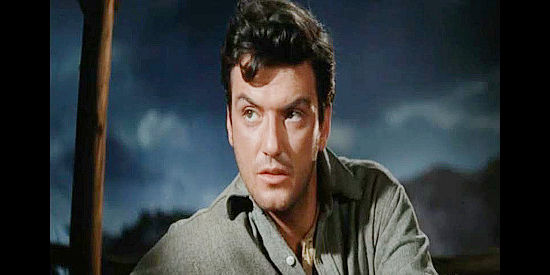
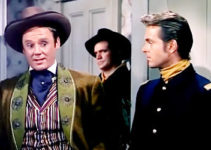
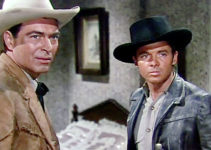
William Campbell as Cabot Young, the hot-headed young Rebel planning a dash for freedom in Escape from Fort Bravo (1953)
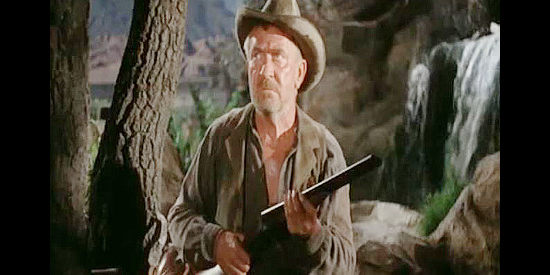
William Demarest as Campbell, a Confederate veteran trying to stop the infighting among his fellow escapees in Escape from Fort Bravo (1953)
Memorable lines:
Carla Forrester: “The women always look beautiful at their weddings. The men always look scared.”
Capt. Roper: “They both get over it.”
Doc: “Roper, there are two big businesses in this world. One is to keep men alive. The other seems to be yours.”
Capt. Roper: “It’s not a world I made.”
Cabot Young: “How’s a decrepit old man like you ever get in the war?”
Campbell: “Because all the smart young me like you was losing it.”
Capt. Roper: “You’re a good officer, Marsh. Only you’re unlucky. You got in the wrong army.”
Capt. Marsh: “But the right cause.”
Roper: “They say that’s the one that wins.”
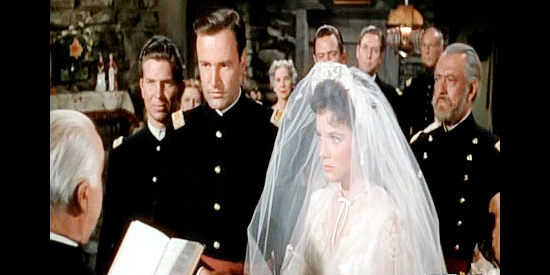
Richard Anderson as Lt. Beecher and Polly Bergen as Alice Owens, getting married in Escape from Fort Bravo (1953)
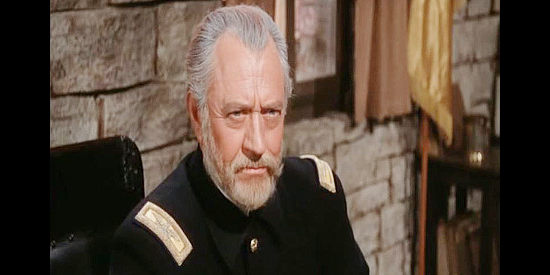
Carl Benton Reid as Col. Owens, filling Capt. Roper in on the Rebel prisoners who escaped in Escape from Fort Bravo (1953)
Capt. Roper: “Symore, I’m pulling out. Take care of those flowers.”
Symore: “Yes, sir.”
Roper: “If you don’t, I’ll dig them up and plant you.”
Symore: “I know you will.”
Roper: “Now, if I don’t come back …
Symore: “You’ll be back. Only the good die young.
Roper: “In that case, I’d say I’ve got a long time.”
Symore: “I’d say forever.”
Capt. Roper, when Beecher complains about the Apache torturing men to death: “When you’re in the grave, Beecher, it doesn’t matter too much how you got there.”
Lt. Beecher: “Well, I think it matters. I think it does.”
Capt. Roper: “Write the War Department.”
Campbell to Cabot Young, when the small patrol is pinned down by Indians: “Why don’t you just take a nice nap? And I’ll wake you when you’re dead.”
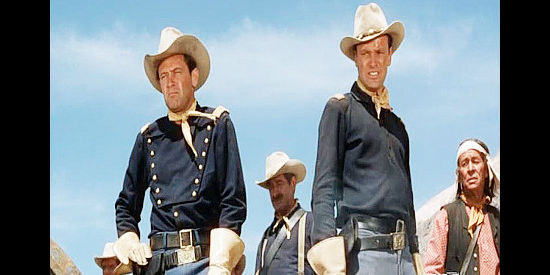
William Holden as Capt. Roper and Richard Anderson as Lt. Beecher, finding troopers staked out and dead in Escape from Fort Bravo (1953)
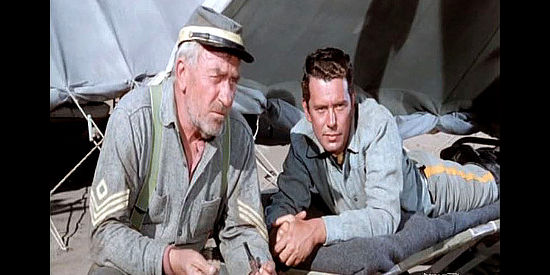
William Demarest as Campbell and John Forsythe as Capt. John Marsh, watching Carla and Roper get closer in Escape from Fort Bravo (1953)
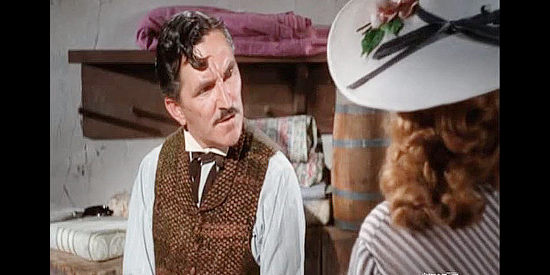
Howard McNear at Watson, the store owner who provides transportation and supplies to the Rebel escapees in Escape from Fort Bravo (1953)
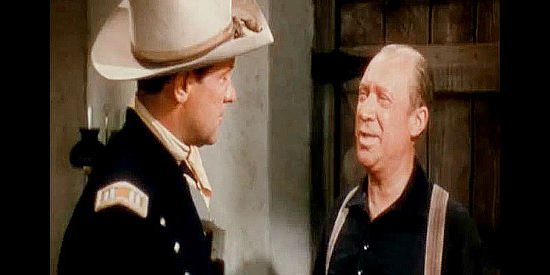
William Newell as Symore, Capt. Roper’s personal assistance, wishing him a safe trip in Escape from Fort Bravo (1953)
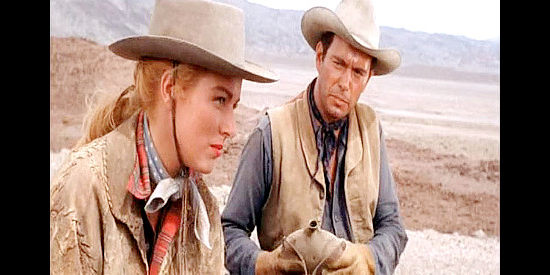
Eleanor Parker as Carla Forester and old flame John Marsh (John Forsythe), fleeing through Indian territory in Escape from Fort Bravo (1953)
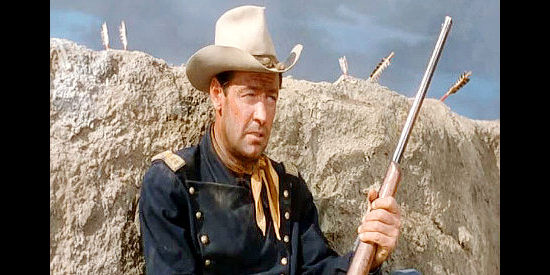
William Holden as Capt. Roper, wondering if there’s a way out of an Apache ambush for his small band in Escape from Fort Bravo (1953)
)
This is a very fine Western and I’m surprised it’s not better known. In fact, I would go so far to say it should qualify as a borderline classic.
This is the first film I’ve seen in which William Holden was the starring attraction. There’s a touch of Gary Cooper to Holden, albeit without the the perpetual sense of being slightly taken aback that is Cooper’s trademark. But Holden’s Captain Roper is clearly a solid and very cool customer, and that’s what’s needed in the character.
Eleanor Parker is great as the vamp out to hoodwink Roper as part of a plot to abet a Confederate breakout from Fort Bravo. Alas, the seductress gets seduced herself. Parker’s performance reminds me somewhat of Denice Darcel’s in Vera Cruz, although slightly more subtle. Then too, EfFB is a far more subtle picture than VC.
Then there’s the marvelous William Demarest as the crusty Confederate inmate who’s a crack shot with a carbine. Demarest’s presence is the reason I purchased this film on DVD and he doesn’t disappoint, although he was almost unrecognizable with the gray hair and profusion of whiskers. Regardless, Demarest has a large role and the film benefits mightily because of it.
Then there’s an interesting character played by John Lupton. The character is named Bailey, he’s a Confederate prisoner and something of a poet. In fact, Bailey reads one of his poems aloud and it appears as though he has genuine talent. Alas, Bailey is also, by his own admission, “yella,” and is in some emotional torment because of the fact. In the end, however, the coward Bailey performs an act of great heroism and saves the day.
It’s something of a mania with me to spot inclusions of high culture in Westerns although they’re rather rare. You just don’t expect to encounter poetry, classical music, Shakespeare, and art in the rough-and-tumble Old West, but it does happen. In the case of EfFB’s poet, it’s interesting to note that, far from being treated with contempt by the hardscrabble ruffians in Fort Bravo, he is treated with considerable sympathy. His comrades don’t bully him, they take pity. Perhaps–and I’m just taking a flyer here–they secretly respect Bailey’s talents and his gentle nature. If so, it’s probably an inaccurate depiction of the response such a figure would have met with in the Old West.
That digression aside, two of the prime highlights of this film are the cinematography and the rather grisly conclusion. There are many great panoramic landscape shots and silhouettes of military vexillations against dramatic sunsets. This sort of scenery is, of course, the stuff Western buffs live for, and EfFB delivers in spades.
As for the conclusion, it is tense and downright spooky. The motley crew from Fort Bravo is pinned down by Mescalero Apaches in a shallow arroyo and matters seem rather hopeless. Nevertheless, the intrepid Yanks and Rebels do manage to bump off some of the attacking Indians, and the succeeding burial chants from the Apaches are downright haunting.
Then too we see repeated volleys of Indian arrows raining down on our heroes and a few of them hit paydirt. It’s a bleak situation and it appears the best hope is that the white folk die from the arrows rather than being scalped and staked down in ant beds–or worse. All’s well that ends well–thanks in no small part to the poet–but it’s certainly touch-and-go.
In short, even though this picture has more kissing than shooting during the first two acts, the conclusion delivers the time-honored Western goods and leaves the viewer with a strong final impression. It’s hard for me to imagine anybody who knows what’s what about Westerns not revering this film mightily.