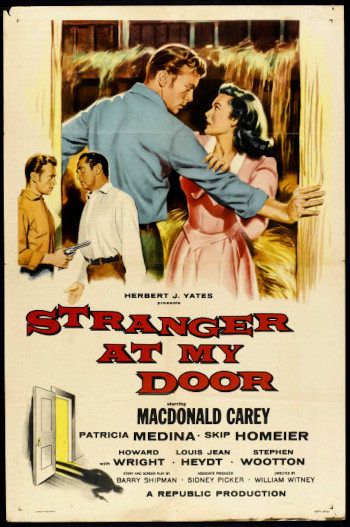
 Skip Homeier plays Clay Anderson, leader of an outlaw gang who flees after a bank robbery and stumbles upon the home of a backwoods preacher (Macdonald Carey as Hollis Jarret).
He lies about his identity to the preacher’s son (Stephen Wootten) and his pretty wife (Patricia Medina as Peg).
But Jarret isn’t fooled; he quickly suspects the young man was part of the holdup gang. He knows it when Anderson tries to steal one of his horses.
Caught in the act, with a posse roaming the countryside, Anderson decides a preacher’s home might not be a bad place to hide from the law after all.
That’s fine with the preacher; he welcomes the chance to bring the outlaw closer to God.
But there’s a chance this stranger might lure the preacher’s much younger wife and son closer to the devil instead.
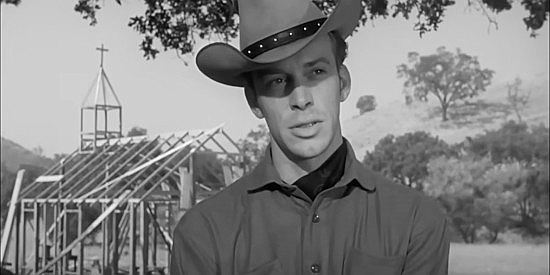
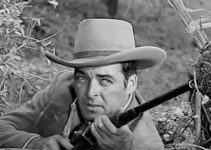
Skip Homeier as Clay Anderson, an outlaw on the run and reluctant to accept Hollis Jarrett’s religion in Stranger at My Door (1956)
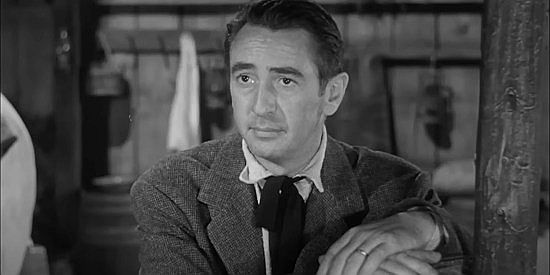
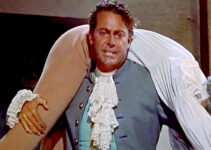
Macdonald Carey as Hollis Jarrett, wise to who has landed on his doorstep and accepting it as a challenge in Stranger at My Door (1956)
 Review:
Well done B Western with Carey turning in probably his best performance in the genre and Homeier making the most of a role much larger than he normally enjoyed.
Sure, the ending becomes a bit too melodramatic and Medina’s performance is full of hysteria, but the film also includes one of the wildest horse taming sequences you’ll find in a Western.
Carey would eventually enjoy stardom as Dr. Tom Norton on the NBC soap opera “Days of Our Lives;” he played the role for three decades.
Wootton, his son here, appeared in several movies and on a number of TV shows before leaving acting in the early 1960s. He later enjoyed a career in insurance and management.
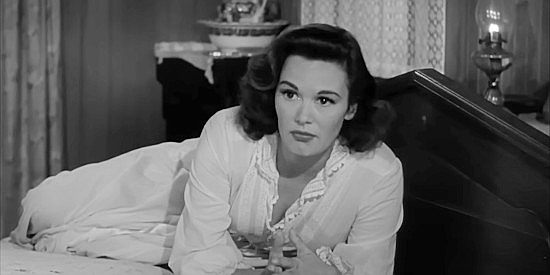
Patricia Medina as Peg Jarrett, wary of the leering stranger her husband has invited into their home in Stranger at My Door (1956)
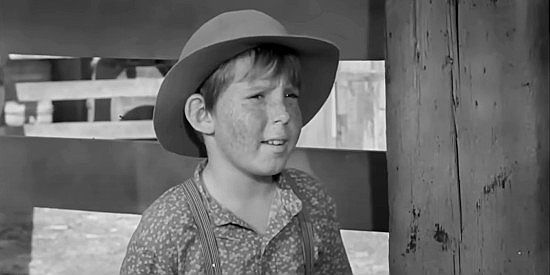
Stephen Wooton as ‘Dodie’ Jarrett, the young boy who admires Clay Anderson in Stranger at My Door (1956)
Directed by:
William Whitney
Cast:
Macdonald Carey … Hollis Jarret
Patricia Medina … Peg Jarret
Skip Homeier … Clay Anderson
Stephen Wootton … “Dodie” Jarret
Louis Jean Heydt … Sheriff Tatum
Howard Wright … “Doc” Parks
Slim Pickens … Ben Silas
Fred Sherman … Mr. Winslow
Malcolm Atterbury … Rev. Hastings
Runtime: 85 min.
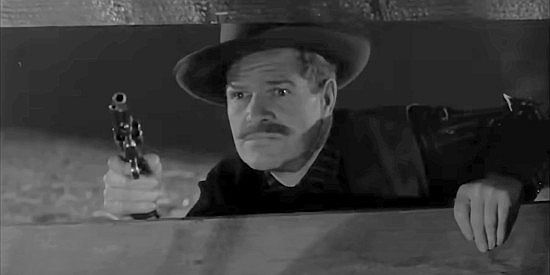
Louis Jean Heydt as Sheriff Tatum, thinking he finally has Clay Anderson cornered in Stranger at My Door (1956)
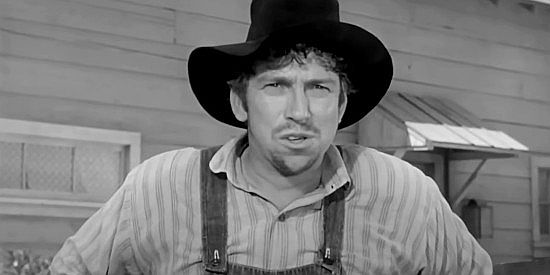
Slim Pickens as Ben Silas, the man who turns over his wild stallion to the Jarrett family in Stranger at My Door (1956)
Memorable lines:
Hollis Jarret to Clay Anderson: “You don’t have to threaten me. I’m glad you’ve decided to stay with us. It isn’t every day a preacher gets a chance to save the soul of an all-fired big sinner like Clay Anderson.”
Peg Jarret: “I love my husband.”
Clay Anderson: “How do you know if you never tried anything different?”
Rev. Jarret: “I see you have no objection to working on a church.”
Clay Anderson: “Seems to be made out of the same material as any other building. Besides I need the exercise. You never can tell when I might have to leave here in a hurry.”
Rev. Jarret: “Don’t you believe in salvation?”
Clay: “Yeah. I suppose it’s different for everybody. For a lot of people, it’s going to be this church we’re building. All the prayers and repentances and trimmings that go with it. For me, salvation is a clean pistol and a good horse. Cheer up, preacher. It’s not your fault. You did a bang-up job of trying.”
Peg Jarret, of her husband: “You’re making a fool of him.”
Clay Anderson: “No. A man has to do that by himself.”
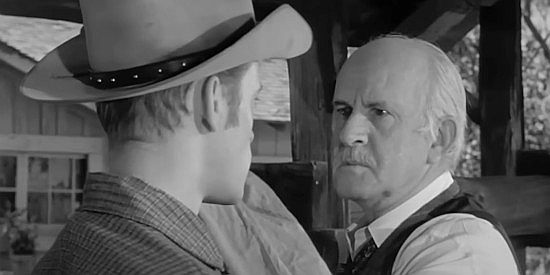
Howard Wright as ‘Doc’ Parks, standing up to Clay Anderson (Skip Homeier) in Stranger at My Door (1956)
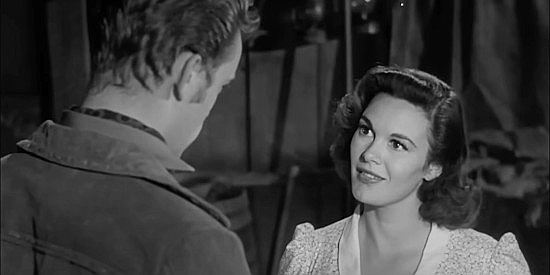
Skip Homeier as Clay Anderson, before he shows his true colors to Peg Jarrett (Patricia Medina) in Stranger at My Door (1956)
)
This is one of the more intense Westerns I have seen. Skip Homeier, who does an excellent job of playing the menacing outlaw Clay Anderson, happens upon an isolated family that seems like helpless prey for the predator. The man of the house is a preacher who appears to be hopelessly naive and idealistic in believing he can save Anderson’s soul. The preacher’s wife is young, voluptuous and a little amorous. Then there’s a little boy who actually seems less of a greenhorn than his parents, although he very quickly falls for the outlaw’s masculine charisma.
The whole mise-en-scene seemingly portends doom for the preacher and his family. And Anderson constantly appars on the verge of inflicting misery on the people who have extended their hospitality to him. In consequence, SaTD has an atmosphere that is borderline oppressive.
Alas, the worst does not come to pass. The preacher-well played by Macdonald Carey, whom I had never even heard of before viewing this film, and looking for all the world like Christopher Lee-proves to be made of far sterner stuff than the viewer might expect. Moreover, his salvific persuasion ultimately has an effect on the nihiilistic Anderson. And the fact that the clergyman prevails probably saves him, his wife and his son.
Carey is really quite superb here. There are moments where a gleam of madness shows in his eyes and the viewer may conclude that he’s a fanatic. But rationality supervenes and the preacher then goes about his practical pursuits.
In some ways SaMD is a variation of the Shane mythos. A mysterious and lethal stranger shows up at the home of an idyllic family, wins over the boy and his dog with his checkered charisma, arouses the sexuality of the wife, and forms an ambivalent relationship with the paterfamilias. But, whereas Shane is a good soul through and through, Clay Anderson is a badman who possesses a tenuous fiber of goodness that could possibly be embroidered into the tapestry of a new man. And in both films, the mysterious interloper suffers a serious wound, fatal in Anderson’s case, perhaps not in Shane’s.
An interesting subplot of this film is a killer horse. Yes, a killer horse. Think of an equine Jaws marauding through a small community in the Old West. You might not think a horse could be frightening, but this rampagaging, hyper-aggressive steed certainly puts fear into all who come into contact with him. The parallel between the horse and the outlaw is so transparent that it is not even metaphorical.
Along with The Bravados (1958), SaMD is the most overtly Christian Western I have seen, with The Bravados evincing Catholic overtones, and SaMD hewing to Protestantism. The possibility of redemption is at the heart of both. But whereas in The Bravados redemption is sought by a fundamentally good man who has made a terrible mistake, in SaMD redemption comes to a genuine villain who finally sees the light in his dying moments. Both are excellent films that give thoughtul treatment to Christianity, a subject that is strangely neglected in the Western genre.