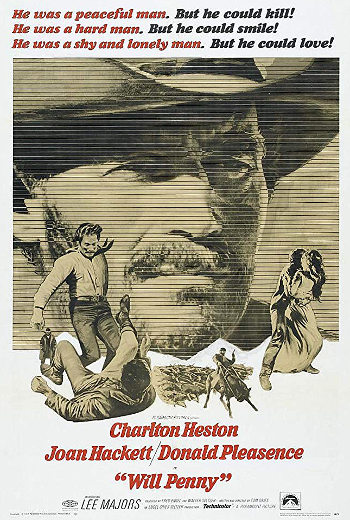
 Charlton Heston is Will Penny, an aging cowhand who rides off at the end of a trail drive looking for a drink of whiskey and his next job.
He and friends Blue (Lee Majors) and Dutchy (Anthony Zerbe) come across a bull elk that looks like it’d make for a tasty meal.
But a dispute breaks out over the animal with a rag-tag family approaching from across the river. Soon, gunfire rings out.
Dutchy is wounded — perhaps by his own bullet. And a son of Preacher Quint (Donald Pleasance) is dead by the river bank. The preacher vows vengeance.
Penny eventually parts from his friends after getting Dutchy to a doctor.
He finds a new job too, manning a line camp for the winter for the Flat Iron ranch.
But he finds his cabin already inhabited by Catherine Allen (Joan Hackett) and her son Horace. They’ve been abandoned by the guide leading them to California where Catherine’s husband has a farm.
Nesters are prohibited on the Flat Iron range, so Will orders them off the property. He wants them gone by the time he returns from checking out the range he’ll be patrolling for the winter.
That’s when Preacher Quint returns with his two remaining sons. By the time they’re done with Will, he’s stabbed, burned, beaten, bleeding and left for dead.
He manages to make it back to the line camp where Catherine nurses him back to health. Over time, he becomes fond of her and her son.
He and Catherine begin re-examining their futures too. Catherine faces one with an unloving husband. Will faces one of endless drifting.
But they won’t have a future if Preacher Quint learns that Will is still alive.
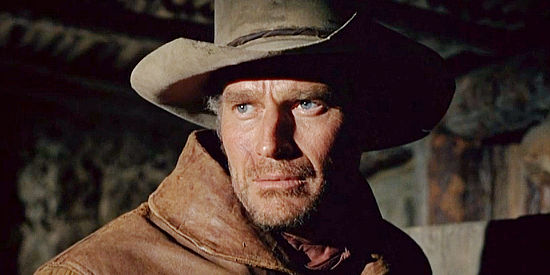
Charlton Heston as Will Penny, discussing the future with Catherine Allen in Will Penny (1967)
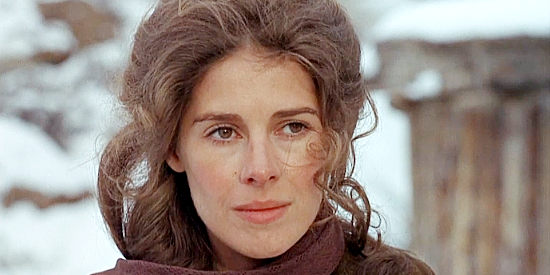
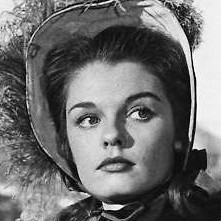
Joan Hackett as Catherine Allen, the woman who finds herself hoping for a brighter future in Will Penny (1967)
 Review:
A very well done Western that comes off as much more realistic than most. At one point, Will Penny even takes Catherine’s son cow chip hunting so there’s enough fuel to heat their cabin for the winter.
Heston’s Will Penny is anything but the romantic version of a cowboy. He bathes eight or nine times a year. He beds a woman occasionally when he gets to town.
If he’s drunk, he’ll let a wounded friend lie in a wagon bed, suffering in the cold, then place a bet on how long that friend will live.
But his encounter with Catherine awakens a yearning for a place to call home, and a yearning to take a young boy under his wing and teach him what he knows about surviving in a harsh West.
Donald Pleasance plays the role of crazed Preacher Quint with gusto. Bruce Dern and Gene Rutherford play the Quint brothers; Preacher wants Catherine to decide which one to “take up with.”
And Jon Gries — the director’s son, using the name Jon Francis — plays Catherine’s boy.
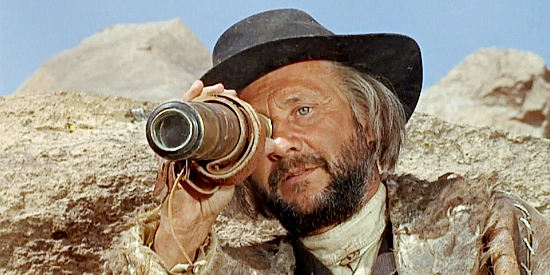
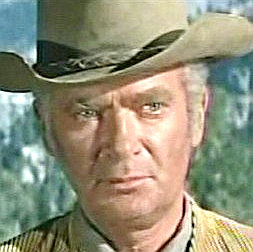
Donald Pleasance as Preacher Quint, spying on Will Penny with revenge on his mind in Will Penny (1967)
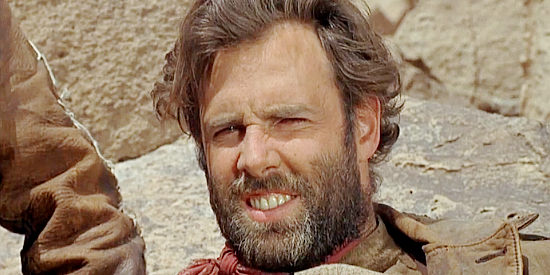
Bruce Den as Rafe Quint, one of Preacher Quint’s sons in Will Penny (1967)
Directed by:
Tom Gries
Cast:
Charlton Heston … WIll Penny
Joan Hackett … Catherine Allen
Donald Pleasance … Preacher Quint
Lee Majors … Blue
Bruce Dern … Rafe Quint
Ben Johnson … Alex
Slim Pickens … Ike Walterstein
Clifton James … Catron
Anthony Zerbe … Dutchy
Roy Jenson … Boetius Sullivan
G.D. Spradlin … Anse Howard
Quentin Dean … Jennie
William Schallert … Dr. Fraker
Lydia Clarke … Mrs. Fraker
Robert Luster … Shem Bodinehe
Dal Jenkins … Sambo
Matt Clark … Romulus Quint
Gene Rutherford … Rufus Quint
Luke Askew … Foxy
Anthony Costello … Bigfoot
Chanin Hale … Girl
Jon Gries … Horace, aka “Button:
as Jon Francis
Runtime: 108 min.
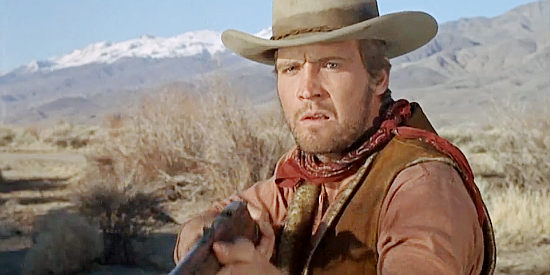
Lee Majors as Blue, a fellow cowboy who has befriended Will Penny in Will Penny (1967)
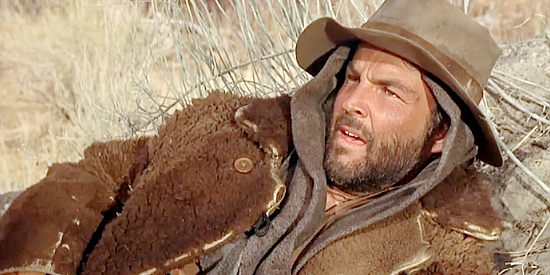
Anthony Zerbe as Dutchy, wounded during the encounter with Preacher Quint and his sons in Will Penny (1967)
Memorable lines:
Preacher Quint, after one of his sons is killed: “Life for life. Eye for eye. Tooth for tooth. Burning for burning. Wound for wound. Strife for strife. Who sheddeth man’s blood, that man shall his blood be shed. You ain’t seen the last of me!”
Dutchy, gunshot: “Will, I’d like to have a sure drink here better than a maybe drink later on.”
Will Penny, after Blue samples his drink: “How’s she taste?”
Blue: “Don’t know. But she sure burns a dollar’s worth.”
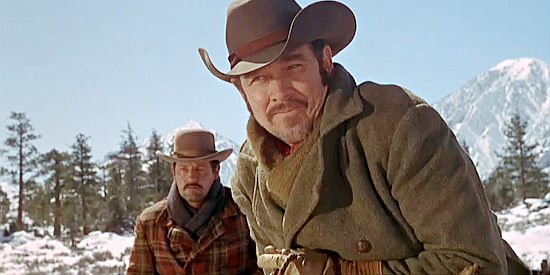
Ben Johnson as Alex, foreman of the Flat Iron Ranch, confronting Will about strangers in his cabin in Will Penny (1967)
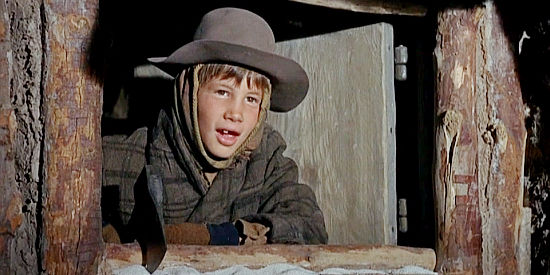
Jon Gries (Jon Francis) as Horace, Catherine’s son, on the watch for Will in Will Penny (1967)
Doctor as Blue and Will unloaded a wounded Dutchy: “He smells like a still. What did you do? Stop on the way to celebrate?”
Alex, ranch foreman, upon hiring Will: “Now, about the pilgrims that come through. As long as they keep moving, fine. And if they take a beef now and then, you don’t do much about that either. But you don’t let nobody stop. That’s the most important thing. Nobody stops on Flat Iron range.”
Will Penny: “What if they don’t move.”
Alex: “They’ll move alright. Won’t nobody say anything about it either.”
Will Penny: “No self-respecting cowhand would be caught dead milking a cow?”
Catherine Allen: “I won’t tell anybody about it.”
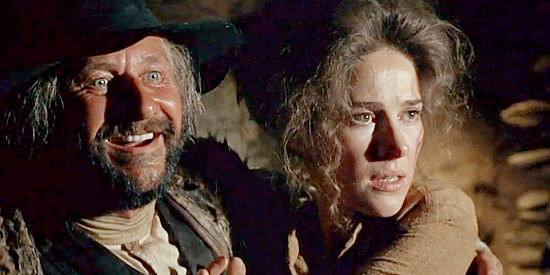
Donald Pleasance as Preacher Quint encouraging Catherine Allen (Joan Hackett) to chose between his sons in Will Penny (1967)
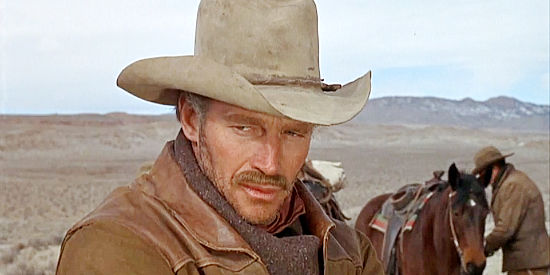
Charlton Heston as Will Penny, contemplating what’s next at the end of a cattle drive in Will Penny (1967)
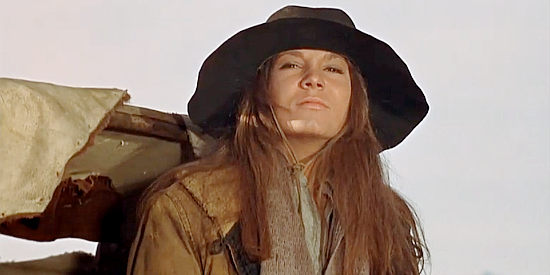
Quentin Dean as Jennie, the girl who travels with Preacher Quint and his sons in Will Penny (1967)
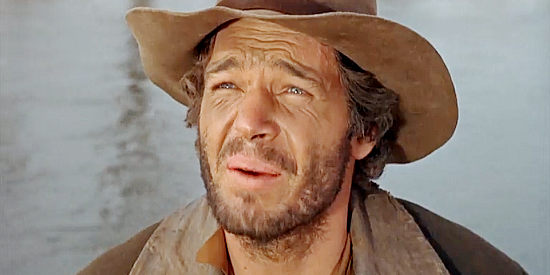
Gene Rutherford as Rufus Quint, one of the preacher’s sons, mourning the loss of a brother in Will Penny (1967)
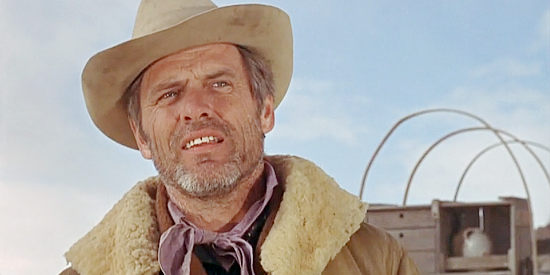
G.D. Spradlin as Anse Howard, the man whose herd Will helps drive to market in Will Penny (1967)
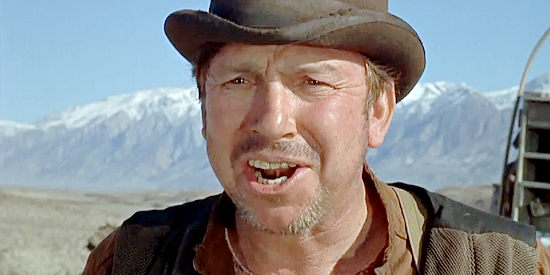
Slim Pickens as Ike Walterstein, cook on the cattle drive in Will Penny (1967)
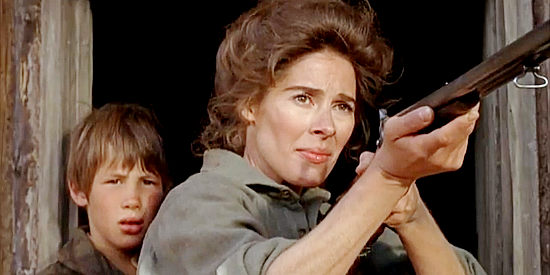
Joan Hackett as Catherine Allen, prepared to defend herself and son Horace (Jon Gries) in Will Penny (1967)
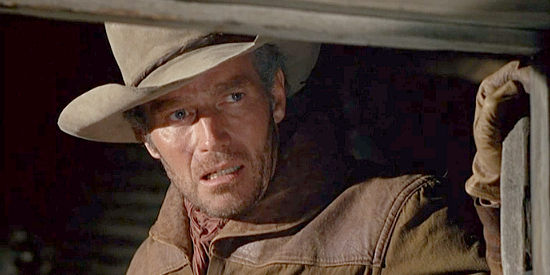
Charlton Heston as Will Penny, forced to confront a half-mad, vengeance seeking man who calls himself Preacher in Will Penny (1967)
)
Quint–“That they elk is ourn”
I’ve heard it said of Will Penny that it “deglamorizes” the Old West. But is this true? Certainly, this film dilates on the harsh, coarse, unsentimental and dangerous aspects of the cowboy’s existence. As related in Will Penny, the cattle drive wasn’t exactly peaches n’ cream. The elements were pitiless, the work difficult and hazardous, and the recompense anything but lavish. The food wasn’t up to Brillat-Savarin’s standards, it was served by surly cooks, and your fellow cowhands stank to high heaven.
But is telling the unvarnished truth “deglamorization”? In point of fact, there aren’t many Westerns that actually glamorize the Old West. Now there are certainly quite a few that sanitize it somewhat. These films show little of the grime and the blood and the pain and the fear and the isolation that were surely common in this place and time. But prettifying something isn’t the same thing as glamorizing it. The Western genre has never pretended that life in the Old West was opulent, refined and beautiful–in short, glamorous. On the contrary, the genre has done a good job of showing life in the Old West as the dangerous, impoverished and nasty grind it so often was. But the Western generally did so in a reserved, somewhat oblique way. And there’s nothing wrong with that. I’m not sure we gain much by witnessing Comanche tortures, men getting their heads blown off, and families living on the verge of starvation.
Will Penny, however, gets us a bit closer to the latter than most Westerns, and that gritty authenticity is definitely part of its appeal. But rather than deglamorization, this is deglorification. No great victories and prizes are won in this film. Charlton Heston’s character of Will Penny doesn’t pluck a motherlode of gold from a creek, he doesn’t fill his pockets with money at the end of an epic cattle drive, he doesn’t outgun the badman on Front Street at high noon, and heck, he doesn’t even ride off into the sunset with the beautiful girl.
Will Penny, this simple–but far from stupid–and humble man is an anonymous cowhand. That is his lot and his life. And in this picture, Penny does accrue no small measure of honor from his decent treatment of a young woman (Joan Hackett’s Catherine Allen) and her son (Jon Gries’ Button Allen) cut adrift in the western wilds. Penny’s protection of mother and son, both from the harsh elements of the high mountains and from a clan of deranged monsters–played by Donald Pleasance, Bruce Dern and Gene Rutherford–is the crux of the plot. And once Will has seen Catherine and Button through the worst of it all, rather than attach himself permanently to them as they would both like, eschews this potential domestic paradise because he fears he would do more harm than good to them. Penny says an agonized adieu to them and returns to his lonesome–but familiar–existence as an Old West cowpuncher. He sacrifices for Catherine and Button, but the sacrifice isn’t glorious. It is not even religious. Rather, it is the natural, but by no means automatic, result of the fundamental decency and honor of a nameless cowboy named Will Penny.
This film scores high with me and I suspect I will appreciate it even more upon further viewings. Heston is perfect. In a world where film sophisticates deigned to give the Western its proper due, he might have won an Oscar. The abortive romance between Penny and Catherine is handled very well. Unlike romance in too many Westerns, there are no hysterics or histrionics, and the female lead isn’t a rebarbative flake. Hackett, one of the daintiest and most delicate flowers ever to grace the silver screen, turns in a fine performance. Slim Pickens is also terrific as a testy but witty keeper of the chuckwagon.
Additionally, David Raksin’s score is marvelous. There was a certain type of music in the air at that time–1966 thru 1970–that wasn’t entirely classical or pop, and it had a certain ethereal wistfulness about it. Songs by Harry Nilsson, Burt Bacharach, and Jimmy Webb exemplified this sound, and Raksin’s score does, too. His music is used rather sparingly in Will Penny, but it meshes well with the film’s dreamy and slightly melancholy mood.
Will Penny, with the exception of febrile performances from Pleasance and Dern, is an austere, understated and unpretentious Western. It is also deeply and earnestly sympathetic to the common man of the Old West, the cowboy. Will Penny is, I dare say, something of a forgotten classic of the Western genre.